Showing posts with label energy. Show all posts

Jul 6, 2009

Trading Pollution: Are Trade Barriers Ever Appropriate?

There seems to be no lack of subjects to write on with the passage of the climate bill through the House. Yet another provision in the bill is to impose import tariffs on goods from countries not meeting U.S. carbon-emitting requirements. As an economist, I would tote our party line that any barriers to free trade are inefficient – but I have to wonder, “Is that true in every case?”

Political reasoning for imposing import tariffs is simply protectionist. Politicians must support, or appear to support, domestic industry and are no doubt being lobbied by many such industries not wanting to conform to the new emission requirements.

But behind the politics there is another reason for why import tariffs might not be considered inefficient. The objective of the climate bill is not, or should not, be to make American industry more or less competitive, nor to make the American people better or worse off financially; the objective is to reduce greenhouse gas emissions through a system of cleaner technology and domestic and international offsets. The climate bill is not for political or economic gain – it is to delay adverse effects of our carbon-excessive lifestyles.

If this is the case, then imagine the effects the bill would have if this provision were not included. Suddenly, it would get more expensive to produce virtually all goods and firms would choose to either trade carbon credits or invest in offsets. These offset opportunities are much more plentiful outside the U.S. and are much less expensive as well, which would entice firms’ offset activities abroad. As domestic prices rise, importing will become more attractive. It should be noted that this does not necessarily imply that goods will be imported from countries allowing total environmental degradation for the purpose of manufacture, but demand for goods will increase in these areas. Consumers would essentially be substituting goods to non-environmentally-regulated countries from regulated-countries; thereby undermining the objective of the bill since the same amount of global carbon will be emitted.


By imposing import restrictions, the government is essentially taxing countries for not upholding certain environmental standards. Unfortunately, there are so many wrongs that go with these sorts of trade barriers that the above argument could not even begin to neutralize.

First, this is the classic case of the U.S. trying to impose American mores on other countries. The U.S. did not sign the Kyoto treaty because we did not want to be held to internationally agreed upon standards; essentially, the U.S. was not ready. Now that the U.S. has decided to take on some environmental responsibility, it assumes every other nation is ready. While many might argue that the U.S. has had the capability of environmental responsibility for years and has recoiled, there are truly many countries that are simply not ready. Who is the U.S. to demand the path in which other countries take?

Further, the provision says that barriers will be imposed on those countries lacking “similar” programs – but what constitutes as similar. Our program focuses on carbon emissions, but there are many other foci a program would take to promote environmental health. China might implement a clean water program which would drastically increase their production costs in just about every industry; and while the objective of the program is the same, to promote a healthier planet, it is quite different and is likely to not be counted as a similar program.

Finally, there is a question of magnitude; will countries be fined a flat tax for not having similar programs? Or will it be based upon a variable element, such as emissions per capita of that country or average emissions of producing a good? Surely, this would create the correct incentives for countries and firms who would adjust production methods until the marginal cost of decreasing emissions equals the increase in marginal revenue from decreasing emissions.

There is always the inevitable trade war that occurs when unilateral trade barriers are imposed – but that is only one of the adverse reactions that will result from import tariffs.

Jul 1, 2009

Undermining Clean Air Objectives

We have covered carbon-offsetting and subsidies that provide misleading signals to consumers. But subsidies do far more damage than just misleading consumers; they undermine the very purpose of the Clean Energy and Security Act bill; which is to reduce greenhouse gas emissions.

By increasing the cost of bad energy goods (by internalizing the externality) then the overall cost of energy to the consumer is increased and this leads to a reduction of energy use. By subsidizing the good energy technologies we reduce the overall cost of energy to consumers thereby causing an increase in, or at the very least, static consumption of energy. The act of subsidizing energy to encourage consumption of clean energy goods over bad energy goods undermines the purpose of the bill in question.

Gilbert E. Metcalf explains the logic and economics of raising prices over subsidizing in his article “Tax Policies for Low-Carbon Energy.” He states that subsidies result in a relative price difference of the two types of goods to encourage consumption in the ‘right direction.’ “If fuel source X causes pollution that is equal to 10 percent of its cost then we can provide the right incentive to fuel users choosing between fuel sources X and Y by raising the price of X by 10% or by lowering the cost of fuel source Y by 1/(1.10) or 9.1%. Either way, the relative cost of fuel source X to Y is now 10% higher than it was prior to the implementation of new energy policy. Either a tax or a subsidy can be effective on the margin of choosing among fuel sources where some sources cause pollution.” Metcalf goes on to explain that the problem lies in the perceived information of the subsidy as explained the previous post. To achieve efficiency, consumers must have perfect information (normally achieved through prices) and by augmenting the prices in the wrong direction, consumers do not realize the true value of the good they are buying.

This is essentially the government playing favourites and losing sight of their true objective. This is exemplified in the subsidies on hybrid cars. Using two cars, the Mazda Tribute Hybrid and the Toyota Corolla, we can see how subsidies can create the wrong incentives for firms. The Mazda Hybrid gets 32 mpg while the Toyota Corolla gets 31. The Toyota Corolla has been engineered to have the highest mpg possible for a non-hybrid car but is not eligible for a subsidy from the government even though Toyota has spent time and energy into making it the most efficient it can be. The Mazda Hybrid is eligible for large subsidies from the government simply because it uses hybrid technology. Very little time and money have been put into making the rest of the car fuel-efficient and instead, has relied solely on the hybrid technology to increase mpg. The subsidy given to the Mazda Hybrid undermines any incentive the firm might have otherwise had to increase mpg through other means such as perfecting the internal combustion engine. Metcalf again argues that “Our tax policy should provide the same incentives to improve mileage regardless of the technology put in place.”

Jun 28, 2009

Why Taxes Trump Subsidies

cartoonstock.com

My last post explored the inefficiencies in the primary objective of the Clean Energy and Security Act bill, mainly carbon-offsetting. This post will focus on the other provisions in the bill, mainly, subsidies in the form of tax credits and business grants for those entities choosing to use clean energy technologies.

I must preface that though I am criticizing the abilities of this bill, it is a monumental legislative step in the right direction; though it must still pass in the senate. A friend of mine who does not believe in global warming has even expressed admiration for the bill and its intentions, though agrees with my assessment of its planned execution of those intentions.

The US government has long suffered from control issues. This bill provides subsidies and tax credits for those people who choose to use energy efficient technologies. To understand why this is not a great idea, we must look at the effect subsidies have on decision-making and rationality. In economics, we assume that people are rational agents acting on perfect information, among other things. If information is perfect, then prices represent the actual cost of the goods produced. By subsidizing clean energy technologies through business grants or tax credits the government is essentially creating prices that do not reflect the true social value of the good. Therefore, more is consumed of these goods than would otherwise be optimal and creates a higher social net cost without the same social net benefit that would have occurred if the prices were representative of the value of the good.

So what would be the solution? Instead of making it cheaper to consume certain energy sources, make it more expensive to consume the bad energy technologies. This may seem to achieve the same objective of having consumers substitute good energy with bad but this results in a more socially optimal solution.

Bad energy goods are labeled “bad” because they create an externality and further, this externality is not internalized in the price. This means that the cost to society of using this good is higher than the price being charged by firms because the firms are not held responsible for the negative effects the result from production and use of the good. By increasing the cost of these bad energy goods we can internalize the externality caused by the goods.

Why is this better? This gives consumers perfect information by way of prices so that they are able to choose the socially optimal level of consumption of both, or just one, good(s). The problem with subsidizing goods is that it gives signals to the consumer that the good creates a positive externality, i.e. it increases social welfare. While clean energy technologies trample less heavily on the earth, solar panels and wind turbines must still be produced by a firm using hazardous materials and non-renewable energy. One cannot argue that using such technologies reverse damage in the atmosphere, they only damage it less; therefore, they do not create a positive externality and should not be subsidized.

Jun 27, 2009

An Energy Bill with a Catch


Yesterday, a monumental energy bill was passed in the House. While liberals and conservatives are shouting out praise or disapproval, respectively, few have looked past party lines to gauge the real effects of the bill.

The bill is attempting to achieve one main objective which is a 17% reduction in economy-wide greenhouse gas emissions by 2020. The proposed strategy is a cap-and-trade system with large amounts of domestic and international carbon offsetting opportunities. There are provisions in the bill which will assist and mitigate the primary objective such as renewable energy requirements on utilities, energy efficiency incentives for consumers and businesses, grants for green jobs, and research and development on carbon sequestering technologies.

Though I support a bill to mitigate use of carbon-producing technologies, I cannot say with confidence that this bill will be able to achieve that. A system of cap-and-trade can be effective but is easily sabotaged with offset credits. The theory behind cap-and-trade (in this case) is that the government will set a limit on CO2 emissions that can be released into the air and then issue permits to businesses to pollute in the specified range. This provides economic incentives to businesses to reduce emissions for whom it is inexpensive to adopt cleaner air technologies. These businesses can then sell their permits to businesses that cannot easily adopt clean air technologies. So far so good. But then the offsets begin. This allows a business to pollute above their permit allowance so long as they invest in carbon offsetting activities. These carbon offsetting activities could be planting trees in Brazil to encouraging US farmers to adopt energy saving farming practices. Businesses will then invest in the offsets until the cost of offsetting reaches the cost of buying permits. The problem is that offsets reverse any intention and effect that capping has - i.e. it is the purpose of the cap to reduce emissions but offsets allow firms to pollute past the cap as long as they pay for it.


Economically, this makes sense. Those who pollute must pay. But the goal of the bill clearly specifies a 17% decrease in greenhouse gas emissions by 2020. If the goal is a reduction, then offsets will not help. If the goal instead is to increase the cost of polluting to reduce consumption, then cap-and-trade with offsets is the right system. it might seem that in both cases the reduction in emissions is realized, but in the first system, without offsets, the amount of emissions is set and final, while the with the offsets, the amount of emissions will depend on a multitude of factors such as firm's cost structures, elasticity of demand for that firms products, elasticity of supply of that firm, etc. And this is where it becomes complicated.

Further, though I have not done the research, it seems a bit far fetched to me that planting forests in South America will offset emissions released in the US. On average, maybe this is true, but this isn't statistics where the average rules. This is our air and I want the air I breath in the US to be clean, not clean "on average."

Apr 13, 2009

Stimulus 101

Two of my former professors from the University of Oregon, Mark Thoma and Tim Duy, were on KLCC the other day talking about the recession. You can listen to it here. They cover topics such as shadow banking, the great moderation, and a great explanation of what a toxic asset really is. They explain just why economists didn't see this coming and why government spending is better than tax cuts during a recession. There's even a diplomatic answer to a livid Eugene commie that calls up. Very entertaining!

Today I have posted my opinion on the Stimulus Package, the goods and the bads. As a Libertarian I have to say I don't like the government mucking around in markets but it seems to be necessary at this point.

I feel that the Stimulus Package is necessary, though the restrictions that have recently been added and the allocation of funds is incorrect. The Great Depression era was the time of little government intervention and a strong reliance on the market. The thought then was that the market always works and that government was superfluous. The solution then, to the Great Depression, was to do nothing. While banks failed, the FED sat idly by and allowed deflation and illiquidity to spiral out of control. The government waited 4 years before finally enacting large amounts of government spending in 1933. By this time, the economy had collapsed and getting out of the hole it dug for itself was near impossible. It was not until 1940 that the economy started to pick up again, 11 years later. Since then, many economists have changed their theories on how the market works through thorough theoretical and empirical research. The stimulus bill has very little theoretical backing other than we know what didn't work before. It is thought that government spending can stimulate the economy, but as to how those funds should be spent, when, and for how long, is all a mystery. I will try to explain why it is so hard to predict: Assume you put 1 million dollars into a small economy for stimulation purposes. Not only do you have to track each dollar of those million, but also the social welfare and surplus value (ie. does that money help individuals or businesses to get loans, does it create public goods, etc) created by each dollar. Then you must quantify this effect. What monetary value does a public good have to each person able to use it.
ex. A bridge is built from a San Francisco peninsula to Oakland (i.e. Bay Bridge). Assume that a combined 2 million people live in Oakland and San Francisco that might regularly use the bridge. Then you must ask, how much time does this save each person, what does each person value their time as (obviously, the wage they work for), and you can get the net benefit by multiplying each person's wage by the time they save using the bridge (instead of going around the mainland) less cost of constructing the bridge. But then there are also other things to consider. The cost of constructing the bridge is money that went to pay for wages and materials (supplied by people and companies) that stimulate the economy. So is this a cost or a benefit? Also, maybe the bridge increases traffic between San Francisco and Oakland from people that don't live in either area. It also might increase tourism. How do you quantify all of these factors? You cannot - and this is why it is so difficult to know exactly how government spending affects the economy.
The stimulus bill is going to put funds into banks, mortgage assistance, infrastructure programs, and energy conservation and alternative fuel research, among many other things. This is where I theoretically disagree with the stimulus package. I feel that infrastructure programs are the best way to stimulate the economy while creating the greatest net benefit. One of the largest negatively affected industry segments of the economy is contractors, construction companies, architectural firms, etc; infrastructure programs would target this labor market while also creating the largest social welfare by building public goods that could last the next 100+ years.

Allocating money to banks and mortgage assistance is a great idea. Many feel that banks should be punished for their belligerent loaning that has characterized the industry for the past 7 years; I am among those people. Unfortunately, it is economically inefficient and dangerous to let the banking sector fail.
ex. Let's take the case of Bank A who has lent long term the money that it has borrowed in the short term. Assume that something happens in the market to dramatically reduce consumer confidence (in this case, excessive consumer debt) and all of the bank's short term lenders (those with savings accounts, etc) come asking for their money back simultaneously. If the bank were inside the capitalist system, Bank A would not be able to pay everyone and it would fail. As soon as other short term lenders (consumers) to Bank B, C, D, etc saw the failing of this Bank A, they would quickly try to pull their money out as well - leading to a complete and devastating collapse of the entire financial sector.
This is why banks are government backed (FDIC) and outside the capitalist system. Since banks can only successfully operate with consumer confidence and trust, it is the government's job to maintain bank stability through regulation so that a troubled bank does not bring down the entire system. The argument for allocating funds to banks is to increase liquidity and therefore increase lending.
ex. To better understand liquidities role in the economy, think of liquidity as a faucet and money is the water that flows from that faucet. In good times, the water runs freely to individuals and firms. But when there is a shock to the system the water pressure supplied to the faucet drops and water cannot flow.
This is essentially what has happened. The shock that dropped the water pressure was the mass number of mortgage defaults and the short period in which they occurred. At the same time, the demand for water has increased and it cannot be supplied quickly enough. The increase in demand has been caused by a collapse of the commercial paper system in which individual investors in money market funds have simply stopped lending. This has put additional strain on banks. The hope is that by injecting money into failing banks, we can increase liquidity in the market and therefore, banks will feel freer to lend to reputable borrowers. Furthermore, the government has started to step in and lend money to firms directly as a stand in for the crippled commercial paper market, another favorable stimulus objective.

Unfortunately, Senator Dodd has added some last-minute restrictions to the stimulus package that disrupts certain economic theories. The restriction most pertinent is the bonus-cap for firms receiving aid. As was signed into the bill, bonuses awarded may not be greater than 1/2 of that person's salary. At first look, I completely agreed with this restriction and was appalled that Summers and Geithner could be against this. But this restriction goes against the theory of economic efficiency.
ex. When speaking of efficiency, past costs must be disregarded for they have already happened and this cannot be undone; we call this the 'sunk cost.' Therefore, since this cost is in the past, it should not effect future decisions. In our case, this 'sunk cost' is the money lost from irresponsible lending and mortgage defaults.
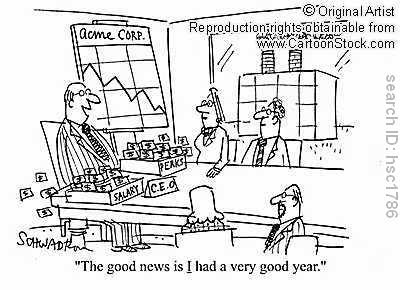

By trying to punish firms for their past behavior by creating a bonus-cap is inefficient and counter productive. Bonuses are incentives; do a good job, you will be rewarded. Unfortunately, in the last 20 years, bonuses have become more of an expectation than a measure of productivity. By interfering with incentive-based pay, the government is essentially creating an atmosphere where top executives will have no motivation to work harder to fix the firm's current economic problems. (It should be noted that an average Wall Street salary before bonuses is around 300-500 thousand dollars, with a handful making around 1 million dollars; average bonuses are upward of 10 million dollars). Further, Summers and Geithner argue that by creating bonus-caps, you are effectively funneling money from the middle class to the upper class.
ex. Let me explain this argument. The pay structure in firms has a very large lower/middle tier where you will find workers that make up the middle class. At the top tier you have relatively less people making about the same in non-bonus salary and receiving excessively large bonuses; this is where you will find upper class workers. If a bonus-cap is imposed then the thinking is that the firm will take money formerly given as salaries to the lower/middle tier workers and funnel it up to the top tier workers to increase base salaries for two purposes, to compensate for drastically reduced salaries due to bonus-cap and to allow larger bonuses to be given (since the bonus must be under 1/2 of non-perk salary).
As a taxpayer, it irks me to think that these people have been rewarded in the past for belligerent behavior but as an economist I feel that efficiency is the best policy. The only way that I could feel perfectly fine with large bonus structures is if there was a disincentive for bad and irresponsible behavior, something like shift in bonus curve so that a bonus at every level would be lower until they proved that they deserved a higher bonus curve.

The largest problem that I find with the stimulus package is the money being allocated to research and development of alternative fuel sources and energy conservation. My sentiments are completely independent of any political affiliation I might have and any feelings I have on energy and the environment. Instead, they rest on an analysis of the targeting and social benefit that can be supplied by R&D. First, R&D in general should never have to be financed by the government. R&D is the outcome of competition between firms in the search to supply a better, cheaper, and more innovative product to consumers. Additionally, government funded R&D projects go straight into the public domain for access by any company - what incentive is there for government funded scientists to produce a result since they will have no chance of obtaining a patent or copyright.
ex. Say the government wants to create a domestic market for hybrid technology. This is pointless because if GM and other US automakers had been forced to be competitive firms instead of relying on government assistance, this technology would already be in use. But because the government has subsidized US automakers with pension loans and through military expenditures, they have not needed to respond to market forces demanding hybrid cars.
Further, how many energy research scientists have become unemployed in the past year. I don't know this number but I have a hunch that this labor market segment has not been so readily affected by the economic downturn. Considering the mass amount of factory, construction, and real estate workers out in the labor market, energy research scientists are a small group comparatively. In the economy, there will always be winners and losers, but the hope is to maximize the net benefit of government action. Creating jobs for research scientists is not a way to maximize the net benefit of this stimulus package. Furthermore, to assume any benefit other than job creation for scientists would require the R&D funding to guarantee an outcome. What I mean by this is that R&D is a game of uncertainty, there is no guarantee that anything will come of it. So the government spends however many billions in R&D and in the end there is a good chance that no alternative energy will be found. It is essentially paying men to dig holes and fill them up, there is no assured social benefit from this.